
Build the House: How a Simple Drawing Conveys Mission Command
While every leader appreciates the intent of mission command, few can recite all seven principles at will. In an age where only our iPhones know our phone numbers, it’s hard for anyone to keep seven of anything straight. This article offers a tool to understand the Army’s approach to command and control (C2) without regurgitating doctrinal references. Leaders can use this step-by-step guide to draw a simple house in a way that explains the logical construction of mission command.
A picture of a house can help us describe (and teach) how the seven principles of mission command come together. The foundational principle is competence, which is the basis of mutual trust; the ceiling represents shared understanding; the walls represent mission orders and commander’s intent; and the roof represents prudent risk and disciplined initiative. Besides offering a memory tool for recalling all seven principles, this article argues that disciplined initiative and risk acceptance are the most critical principles to the mission command leadership philosophy. Importantly, this article argues that those top two critical components cannot be effective without first establishing the first five.
This simple image can be drawn on a whiteboard, a slide, or the back of a napkin.[1]
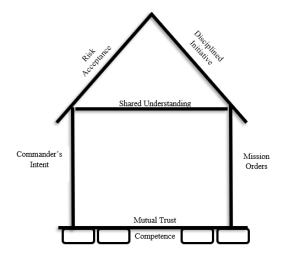
Figure 1. Concept of Mission Command as a House. Drawing by COL (Ret.) Richard Creed and COL Scott Pence
Five years after publishing our current doctrine about the mission command approach to command and control, leaders still struggle with how to think about the principles of mission command.[2] One indicator is how often leaders use mission command as a substitute for command and control (C2). This indicates they are unfamiliar with what ADP 6-0 says, which, in turn, makes it difficult to train, educate, and develop leaders who understand how the mission command approach is supposed to work.
Step #1: Draw the Foundation and the Floor
Competence
The Foundation
The most important feature of any house is its foundation. The walls and roof collapse when the foundation is unsuited to bear the weight of the structure. Army formations are no different. Without a foundation of competent people, commanders cannot easily employ the other principles of mission command – they must exert more direct control over subordinate decision making during the trials of combat. Focusing all decision-making demands on a single person quickly reduces combat effectiveness and ultimately collapses a formation’s C2 system, especially when a unit faces new or unfamiliar circumstances during a fight.
Competence results from a blend of institutional, unit-level, and individual development. When we are confident in the competence of others above and below us, we implicitly trust they can do their jobs in a variety of circumstances because we judge them as capable.[3]
Mutual Trust
The Ground Floor
Mutual trust starts with military professionals knowing they can depend upon one another to perform their jobs. The degree of mutual trust is based upon the degree of confidence that the leader and the led have in each other’s abilities. Subordinates are more willing to take initiative and innovate when they believe their commander trusts them. Commanders show trust when they allow subordinates to exercise initiative and learn from their mistakes. Subordinates earn trust when they don’t make the same mistakes twice and demonstrate sound judgment. It goes both ways – commanders grant more authority to those subordinates who demonstrate tactical and technical ability, but they must provide opportunities to develop those abilities. When homeowners see cracks in the floor, they should be concerned because it could impact the entire structure. In a military unit, cracks in mutual trust can impact mission accomplishment.
Step #2 Draw the Walls
Commander’s Intent and Mission Orders
The Walls
Commander’s intent and mission orders form the two exterior walls in our drawing. While extending up from the foundation and ground floor, they are not structurally sound unless they are strongly linked to a shared understanding above ground level. It is the degree of shared understanding across echelons that governs how commanders construct their intent and the extent to which they can issue mission orders.
Commander’s Intent
Commanders write their intent (and ideally deliver it personally) in a way that Soldiers two echelons down can easily remember and understand. The commander’s intent is a clear, concise statement of the operation’s purpose that enables subordinates to achieve the desired results without further orders, even when the mission does not turn out as planned.
Mission Orders
Mission orders are directives that emphasize the results subordinates are to attain, not how they are to achieve them. Mission orders only contain the most essential elements – general instructions outlining the principal objective and specific missions – while leaving the details of execution to subordinates.
Typically, mission orders dictate one or more major tasks for a subordinate, linked by purpose. They work best when focused on the “why” and not the “how.” Understanding the purpose of the mission allows the subordinate maximum flexibility to determine all the other supporting tasks and how to execute them.
Step #3: Draw the Ceiling
Shared Understanding
The Ceiling
Shared understanding forms the basis for unity of effort. It starts with Army doctrine and PME that instills a common approach to operations and shared professional language. Commanders have the responsibility to ensure that they and their subordinates have the same understanding of the mission and what is expected of them.
Commanders adjust their level of control based on the level of shared understanding, trust, competence, and the situation.[4] The necessary level of control directly informs how directive their commander’s intent statements and orders need to be.
Step #4 Draw the Roof
Disciplined Initiative and Risk Acceptance
The Roof
The roof of our two-dimensional mission command house, like a real house, is why we build the house in the first place. The reason mission command is so impactful is the ability to empower junior leaders to execute disciplined initiative and take acceptable risk.
During the 2019 doctrine review process, Army senior leaders spent the most time refining these two principles. Both represent an evolution of similar ideas in older doctrine, simplified and clarified for preparing leaders for a mission command approach to operations during conventional warfare against the most capable enemies.
We deliberately link disciplined initiative and risk acceptance for a simple reason: taking initiative necessarily requires accepting some level of risk. And that risk tends to float upward. When a subordinate accepts risk, they are also accepting it for their commander. The only way the mission command approach works over time is when subordinates demonstrate initiative in a disciplined fashion. Laissez-faire initiative compounds risk over time, and that cumulative risk could eventually cause an operation to fail.
Disciplined Initiative
Disciplined initiative is defined as initiative exercised within the right and left limits of a commander’s intent. Disciplined initiative means subordinates follow their orders until either the enemy does something unexpected, there is a new development, or a golden opportunity presents itself. The subordinate leader is then empowered and expected to take action to adjust to the new situation, reporting to the commander when able to do so. When exercising initiative, subordinate commanders should ask themselves at least two questions before adjusting the plan: 1) Do the benefits of the new action outweigh the risk of desynchronizing the overall operation? 2) Does this deviation from the plan further my higher commanders’ intent one and two levels up?
Risk Acceptance
Accepting the right amount of risk, given available information, is the heart of the military profession. The greatest risk to mutual trust is leaders who make poor risk acceptance decisions. An obvious example would be a leader who accepts high risk for a unit when the situation does not warrant it, jeopardizing human lives for questionable gain. Less obvious examples include situations in which multiple subordinate leaders accept risk without informing their commander, who is unaware of the risk accumulating across the larger formation over time. Alternatively, consider a leader who refuses to accept any risk to their own force to achieve worthwhile objectives, thereby putting every other unit in the formation and the mission at risk. None of these is a good situation. We avoid them through commander-to-commander dialogue, situational awareness, and attention to the other principles of mission command. Leaders determine the appropriate amount of risk acceptance by understanding the commander’s intent, bolstered by mission orders within the context of shared understanding.
Context Matters
The mission command approach requires discipline, a high level of training, and an understanding that context matters. There are times when leaders must be very prescriptive with subordinates, particularly when synchronizing complex operations with many moving parts or when adhering to a process is the only way to get a specific outcome. Military history is rife with examples of why decentralized execution makes the difference when conditions are rapidly changing and uncertainty is the norm. When subordinates understand, display initiative, and accept risk to create opportunities, the formation becomes capable of adapting quickly to changing battlefield conditions. Knowing the difference between those types of conditions and situations where less centralized approaches are necessary is part of being an effective leader and follower.
Conclusion
What we choose to commit to memory signals what is important to us. Thinking about the principles of mission command using the house analogy might help leaders explain, teach, and model the Army’s philosophy of C2: mission command. Talking about it is not good enough. We all must put in the time and effort – the work – to develop subordinates who understand mission command and then pay it forward to their own subordinates. In an age of limited attention spans, remembering seven principles of anything can be a challenge. By making it easier to understand and remember, we hope this technique facilitates a broader understanding of mission command and its components.
[1] While not artistically talented anyway, the authors purposely drew this image as badly as possible in order to show how simply it can be done. Better artists will draw better houses.
[2] U.S. Department of the Army, Mission Command: Command and Control of Army Forces, (Washington, DC: Department of the Army, 2019) https://armypubs.army.mil/ProductMaps/PubForm/Details.aspx?PUB_ID=1007502
[3] U.S. Department of the Army, Mission Command: Command and Control of Army Forces, (Washington, DC: Department of the Army, 2019), p. 1-7 https://armypubs.army.mil/ProductMaps/PubForm/Details.aspx?PUB_ID=1007502
[4] Paragraph 1-25 and Figure 1-1, Levels of Control, are helpful for understanding levels of control within the mission command approach. U.S. Department of the Army, Mission Command: Command and Control of Army Forces, (Washington, DC: Department of the Army, 2019), p. 1-7 https://armypubs.army.mil/ProductMaps/PubForm/Details.aspx?PUB_ID=1007502
About the Authors:
COL Scott Pence, U.S. Army, is the Chief, G-8 Maneuver Ground Panel, at HQDA, The Pentagon. He was the garrison commander of Fort Bragg, North Carolina and the Commander of 5-73 Cavalry Squadron, 82nd Airborne Division.
COL Rich Creed, U.S. Army Retired, is the Director of Combined Arms Doctrine at Fort Leavenworth, Kansas. He is a former battalion and brigade commander who co-authored ADP 6-0 (Mission Command, C2 of Army Forces) and FM 3-0 (Operations).


