The Leader You Think You Are
The Leader You Think You Are vs. the Leader Others Experience
As a junior officer, you will quickly learn that technical competence and formal authority are not enough to lead effectively. You will work with Non-Commissioned Officers and even Senior Non-Commissioned Officers (NCOs) who understand the organization better than you do. You will encounter officers who are exceptionally skilled at navigating the service but seem primarily concerned with themselves. You will also meet leaders who genuinely care about their people but struggle to understand how decisions, personalities, and organizational dynamics interact. The challenge for a junior officer is learning to recognize these differences—and, perhaps more importantly, recognizing them in yourself. I offer a simple framework for doing so: the WOLF Leadership Orientation Model. The model asks officers to consider two questions about themselves and the leaders around them: How well do I understand the organization in which I operate, and who am I primarily looking out for—myself or others? The answers create four leadership orientations: Wolf, Lion, Fox, and Otter.
The purpose of the model is not to put leaders into boxes or assign good and bad labels. Instead, it provides a simple way to think about leadership strengths, blind spots, and developmental needs. Used honestly—and preferably with feedback from people who work with you—it can help junior officers become more self-aware, navigate their organizations more effectively, and develop into better leaders.
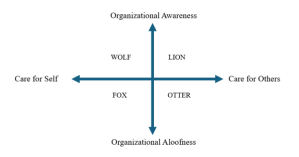
The Wolf–Lion–Fox–Otter Framework
The WOLF model is structured as a two-by-two matrix formed by organizational awareness (high vs. low) and care orientation (self vs. others; see Figure 1).
High Organizational Awareness
Leaders high in organizational awareness demonstrate contextual intelligence and adaptive judgment.
- Wolf (High Awareness, High Care for Self): Wolves are strategically sophisticated and primarily self-protective. Rather than emphasizing dominance, Wolves focus on risk management, positioning, and survival within complex systems. Their effectiveness derives from accurate system reading and disciplined self-interest, particularly in competitive or politically charged environments. Am I behaving like a wolf, all the time? How must that be for others to be around me?
- Lion (High Awareness, High Care for Others): Lions combine systems awareness with a strong commitment to others’ well-being. They leverage organizational insight to protect, develop, and advocate for their people, aligning ethical influence with contextual realism. Lions are often associated with trust, loyalty, and sustainable influence (Brown & Treviño, 2006). However, occupying this quadrant in perpetuity may lead to burnout!
Low Organizational Awareness (Organizational Aloofness)
Leaders low in organizational awareness exhibit limited sensitivity to informal structures and systemic consequences.
- Fox (Low Awareness, High Care for Self): Foxes prioritize self-interest but lack deep organizational understanding. Their behavior may appear opportunistic or reactive, reflecting misalignment with system dynamics. While the service may reward foxes with awards and prestige assignments in the short run, it may catch up to them since they may be organizationally aloof.
- Otter (Low Awareness, High Care for Others): Otters are relationally oriented and well-intentioned but often naïve about organizational realities. Despite strong ethical intent, their lack of system awareness may expose themselves or others to unintended risk. Otters are very caring, but may lose sight of crucial career milestones and therefore may be rendered ineffective.
What Should a Junior Officer Do With This?
First, identify where you think you fall on the WOLF framework. Then ask someone who knows you well—ideally a trusted NCO, mentor, or supervisor—to place you on the same matrix. The differences between your assessment and theirs may be more valuable than the quadrant itself. Second, identify your blind spot. If you are an Otter, your next developmental challenge may be learning how the organization actually works without losing the concern for others that makes you effective. If you are a Wolf, your challenge may be learning when protecting yourself has begun to come at the expense of your people. Foxes may need to develop both organizational awareness and a greater concern for others, while Lions may need to remember that taking care of themselves is part of taking care of their teams.
Finally, remember that the goal is not to become a Lion, a Wolf, a Fox, or an Otter. The goal is to become a leader who understands the organization, understands people, and understands himself or herself well enough to know what the situation requires. The most useful question is therefore not, “Which animal am I?” It is “What does my team need from me right now, and what do I need to develop to provide it?”
Author Note
William T. Glick https://orcid.org/0009-0005-6843-5697
Correspondence concerning this article should be addressed to William T. Glick, Instructional Systems Specialist, U.S. Coast Guard Academy, 31 Mohegan Ave., New London, CT, 06320. Email: William.T.Glick@uscga.edu